In 2026, choosing a Belt Cutting Machine is less about finding the fastest model and more about matching the machine to your actual work. A shop cutting narrow leather straps has different needs from a factory processing woven webbing or rubber. Material thickness, belt width, daily volume, and required edge quality all affect the right choice. Small details matter.
Start by checking the machine’s cutting method, adjustment range, and compatibility with your materials. Ask how it handles repeated cuts, changing widths, and long production runs. A clean edge on a sample piece is useful evidence; a sales claim alone is not. Pay attention to blade replacement, routine maintenance, operator training, and available technical support. These practical factors can shape total cost as much as the purchase price. Safety features and clear operating instructions deserve the same attention.
This guide outlines how to compare machine types, evaluate essential specifications, and assess suppliers before making a decision. It also considers how automation, workspace, and expected production growth may influence your choice. No checklist removes every uncertainty. Materials can behave differently in real production than they do during a brief demonstration, and that is easy to overlook. Request a test using your own material when possible, then compare the cut quality and setup time. A careful decision should rest on observable performance, credible support, and the demands of your process—not on impressive numbers alone.
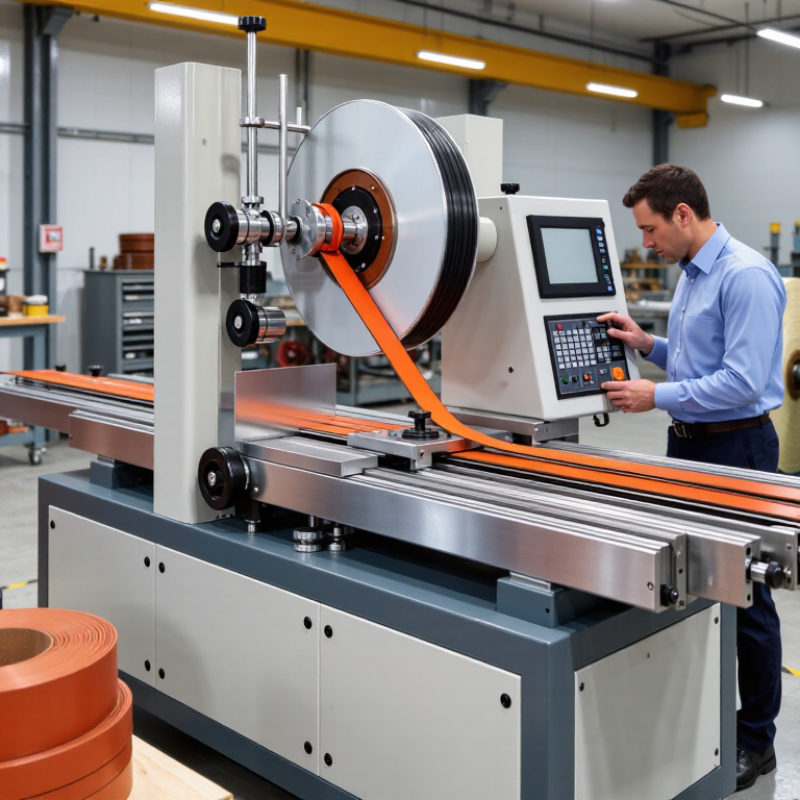
Belt cutting machines differ mainly in how they handle material, thickness, and production volume. Rotary slitting machines cut continuous rolls into narrow strips, making them useful for webbing and uniform belt stock. CNC oscillating-knife systems follow programmed shapes and suit flexible, layered materials where precise patterns matter. For thick rubber or reinforced conveyor belting, a guillotine or hydraulic cutter can deliver a straight, forceful cut. Hot knives work well on synthetic webbing because they seal its edges, but they are not suitable for every material.
The application matters more than the machine label. Grand View Research’s 2023 technical textiles report valued that market at USD 213.3 billion in 2022, reflecting broad demand for engineered fabrics used in industrial products. For a shop processing coated fabric, check whether the blade leaves clean edges without dragging the coating. For rubber belts, inspect the cut face for fraying or exposed reinforcement. Measure your thickest stock, too. A machine rated for average material may struggle with occasional heavy-duty jobs. No machine wins every job. A small compromise in speed or edge quality may be acceptable, but it should be tested on actual production material before purchase.
Start with the belt material, not the machine’s advertised speed. Woven nylon can stretch or fray at the edge, while leather may vary in thickness across one strip. Rubber belts can behave differently again. Check the material’s stiffness, surface, and tendency to slip, then test representative samples with the intended blade and feed method. A clean cut on a short sample is useful, but it does not prove consistent results across a full roll.
Measure the widest belt and the thickest section you expect to process. Leave room for guides and clamps, not just the cutting head. Record thickness variations, too; layered or uneven stock can affect cut quality. If a belt shifts during feeding, the final width may drift even when the blade is sharp. That detail is easy to miss. Ask for a test using your own material and inspect several cuts for fraying, compression, and dimensional consistency.
Estimate daily output by considering setup time, loading, cutting, and changeovers—not only the machine’s stated cycle rate. Note how often operators switch belt sizes and how much length they handle per batch. A faster machine may not help if adjustments take several minutes each time. I would not rely on one sample or one production estimate alone. Compare repeatability across a realistic run, and keep a record of cut width, thickness, speed, and any defects.
Choosing the best belt cutting machine begins with the material and edge quality you need. Rotary blades suit continuous, flexible stock; guillotine systems make clean, square cuts on stacked layers. Hot knives can seal synthetic edges, but may leave a hard bead or odor. Test your actual belt width, thickness, and finish. A sample cut beats a brochure.
Precision depends on more than the blade. Check cut-length repeatability, feed stability, and how easily operators adjust settings. Ask for measured results across several runs, not one perfect sample. Speed is not output. Deloitte’s 2025 Smart Manufacturing and Operations Survey found that 92% of surveyed manufacturers view smart manufacturing as a competitiveness driver over the next three years. Still, automation only helps when feeding, inspection, and material changes keep pace.
Match automation to real production needs. A programmable stop may be enough for short runs; high-volume lines may benefit from automatic feeding and recipe storage. The International Federation of Robotics reported 4,281,585 industrial robots operating worldwide in 2023, up 10% from 2022. That growth signals broader automation adoption, not a guarantee of faster belt cutting. Measure total cycle time, including changeovers and rejected pieces. One awkward detail: operators may bypass controls that slow them down. Include them in machine trials.
Comparing cutting methods by typical precision, speed, and automation
Ratings use a 1–5 relative capability scale, not measured production data. Actual results depend on belt material, thickness, cut geometry, tooling, and machine configuration. Rotary and CNC knife systems suit many non-metal-reinforced belts; hot knives are intended for compatible thermoplastic materials, while laser cutting can create heat-affected edges. Test with your production material before choosing.
Choosing a belt cutting machine means looking beyond its quoted price. Inspect the blade guard, emergency stop, and material-holding system during a live demonstration. Watch how an operator loads a belt and clears offcuts. Small details matter. A machine that requires awkward hand movements may create avoidable risks, even when its safety features look convincing on paper. Ask how guards are checked and what training is included.
Maintenance affects both uptime and cutting quality. Ask how often blades need changing, which parts are considered wear items, and whether routine adjustments require special tools. Request a sample maintenance schedule and a clear parts list. Then estimate the cost of blades, service visits, and expected downtime over several years. The cheapest quote may not stay cheap. A spreadsheet can make these estimates look more certain than they are; actual wear depends on materials, workload, and operator habits.
Supplier support deserves the same scrutiny as machine specifications. Ask how quickly technical questions are answered, whether replacement parts are stocked locally, and what happens when a machine stops during a production shift. Ask for references from businesses with similar cutting needs. Ask for proof. A polished demonstration is useful, but it cannot show every service delay or maintenance surprise. I would leave room for those unknowns when comparing offers.
Choosing a belt cutting machine in 2026 starts with the material, not the advertised speed. Measure belt width, thickness, stiffness, and surface finish across real production batches. A machine that cuts 3 mm leather may handle layered synthetic webbing differently, even at the same nominal width. Check the cutting method, usable work area, feed accuracy, and adjustment range against your tightest length tolerance. Small details matter. Request sample cuts using your own material, then inspect the edges, length variation, and any signs of heat damage or fraying.
Match capacity to realistic demand. Compare cutting speed with setup time, loading, and blade changes; a high headline rate can hide slow changeovers. Confirm which tooling is included, how often consumables need replacement, and whether operators can perform routine adjustments. For repeat jobs, programmable lengths and steady feed control may reduce scrap more than extra speed. Ask for documented tolerances and clear maintenance instructions. Check guarding and emergency stops in person. A clean demonstration is not enough. I would also test awkward roll handling and a short production run; those checks can reveal practical issues that a specification sheet misses.
Use this checklist to compare machines against your material, product dimensions, throughput, and workplace requirements. The targets below are practical starting points, not universal specifications; confirm them with the machine supplier and a production trial.
| Selection criterion | Machine specification to check | How to match it to your work | Practical verification |
|---|---|---|---|
| Material and construction | Supported material types, such as rubber, coated fabric, leather, webbing, or composite belt stock; permitted hardness and reinforcement | Choose a machine and blade configuration approved for the actual belt material. Reinforced, abrasive, or heat-sensitive materials may need different tooling or cutting methods. | Run samples from each material grade and inspect for fraying, delamination, edge deformation, and heat damage. |
| Maximum cutting width | Maximum roll or sheet width and usable cutting width, stated separately where applicable | The usable width must cover the widest incoming stock, including any edge-trimming allowance. Do not assume the machine’s maximum roll width equals its usable cutting width. | Confirm the maximum width in the machine drawing and test the widest stock you expect to process. |
| Roll diameter and weight | Maximum roll diameter, roll width, loading method, and permitted roll mass | Size the unwind stand for your largest incoming roll. Heavy rolls may require powered loading or a lifting aid compatible with the work area. | Check the roll limits against supplier data and verify that loading and unloading can be done safely. |
| Cut width and blade setup | Minimum and maximum finished width, blade count, blade spacing, and adjustment method | Check that the machine can produce every required belt width and that setup changes are manageable for your product mix. | Measure multiple strips across the web after setup; check both width consistency and edge quality. |
| Thickness and number of layers | Supported material thickness, cutting capacity, and whether single-layer or multi-layer cutting is permitted | Match the stated capacity to the thickest material and actual layer count. Cutting multiple layers can affect dimensional accuracy and edge quality. | Trial the thickest approved material and inspect cuts through the full thickness for incomplete separation or compression. |
| Cut-to-length capability | Supported length range, feeding method, length-setting interface, and stated length tolerance | For repeatable individual belt lengths, consider controlled feed and length presets. Verify whether the quoted tolerance applies to your material and operating conditions. | Measure a batch at short, medium, and long settings, then compare results with your product tolerances. |
| Accuracy and repeatability | Separate stated tolerances for strip width, cut length, and repeatability; measurement conditions | Use your drawing tolerances as the acceptance limits. Material stretch, feed tension, blade condition, and measurement method can influence results. | Request documented sample results from a representative run rather than relying only on a nominal specification. |
| Production rate | Feed speed, cut cycles per minute where relevant, and rated output under stated conditions | Compare effective output for your product and material, including loading, setup, inspection, and changeover time—not just the maximum feed speed. | Time a representative production run and record good parts per hour, rejects, and operator involvement. |
| Cutting method and edge finish | Blade or knife type, cold or heated cutting options, and approved materials for each method | Select a method that produces the required edge without damaging coatings or reinforcement. Heated cutting may seal some synthetic edges but is unsuitable for every material. | Inspect sample edges and confirm that any heat-related process is appropriate for the material and workplace controls. |
| Feed control and tension | Feed rollers, tension adjustment, tracking guides, and supported control options | Stable tracking and suitable tension help reduce skew and length variation, especially with flexible or stretch-prone stock. | Run the material at the intended operating speed and check for wandering, wrinkles, slippage, or uneven feed. |
| Automation and changeovers | Manual, semi-automatic, or programmable operation; recipe storage; setup adjustment features | For frequent changes between sizes, assess recipe recall and setup time. Automation is most useful when it reduces handling or errors in a repeatable process. | Have an operator complete a real product changeover and record the time, adjustments, and first-piece results. |
| Safety and guarding | Blade guarding, emergency stops, interlocks where applicable, safe loading access, and operating instructions | Assess the complete machine and task against applicable workplace safety requirements. Confirm that guards do not need to be bypassed during normal operation. | Review the risk assessment, guarding, emergency-stop access, and maintenance procedures before purchase and installation. |
| Utilities and installation | Electrical supply, air requirements if applicable, machine footprint, operating clearance, and floor loading | Verify the available power and compressed-air supply, if required, and allow space for material handling, maintenance, and safe operator access. | Compare installation drawings and utility requirements with the intended production area before ordering. |
| Maintenance and operating cost | Blade replacement procedure, wear-part availability, routine service needs, and operator training requirements | Compare total operating needs, including tooling, maintenance time, setup labor, and expected material waste, rather than purchase price alone. | Ask for a maintenance schedule, parts list, and training plan; include these costs in the equipment evaluation. |